


Though I haven’t published much in the past year, I have written many words. More than 100,000 of them, in fact. That long effort has now borne fruit.
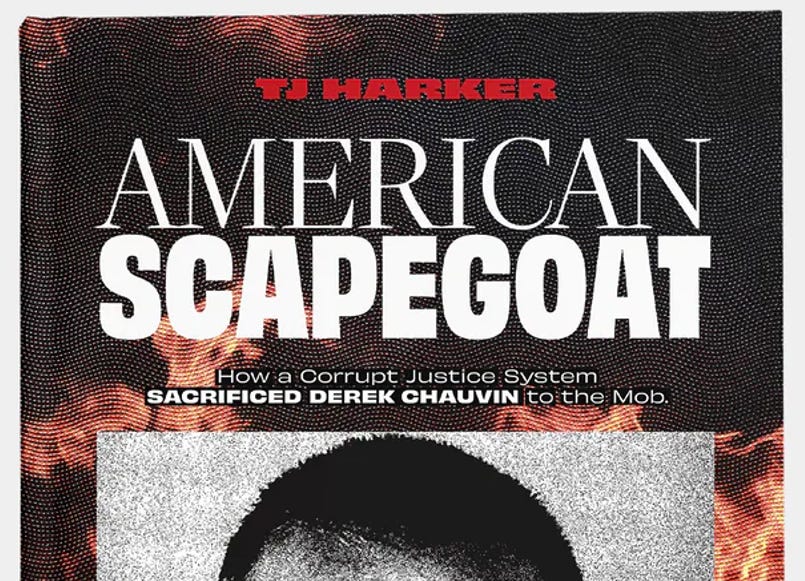
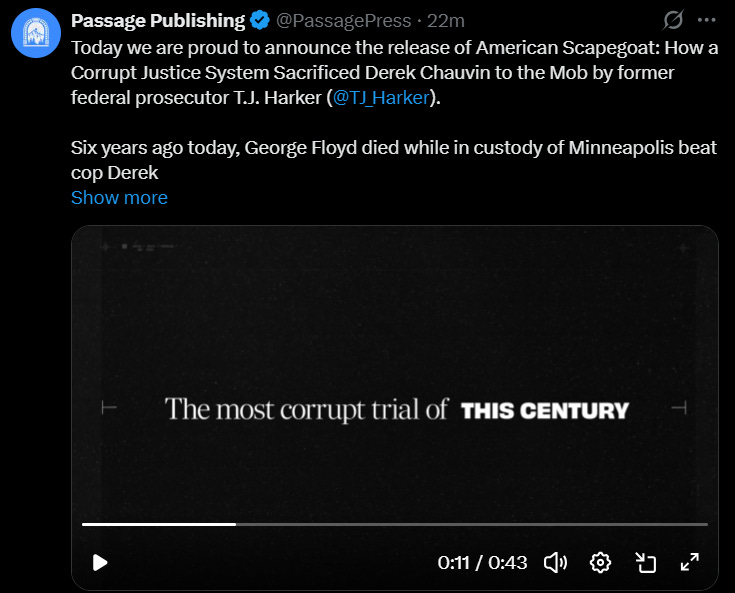
Earlier this morning, on the sixth anniversary of the death of George Floyd, Passage Publishing announced the launch my first book: American Scapegoat: How a Corrupt Justice System Sacrificed Derek Chauvin to the Mob.
Writing this book proved more challenging than I anticipated. I read thousands of court filings. I viewed and reviewed hundreds of hours of testimony. I spoke with people who lived through the chaos in Minnesota following Floyd’s death, the state trial of Officer Chauvin, the federal trial of Officers Tou Thao, Alexander Kueng, and Thomas Lane, and everything in between. And I spoke with outside experts, including doctors, lawyers, cops, government officials, and even a professional MMA fighter with experience in Brazilian Jiu Jitsu.
I expected to write a book that dissected the evidence from my vantage as a former federal and state prosecutor. I intended to weigh that evidence to answer, as dispassionately as I could, the following question: Did the evidence prove beyond a reasonable doubt that Officer Derek Chauvin murdered George Floyd? In other words, I intended to write a book that weighed the evidence against the legal standard, without answering the harder question: Did he do it?
But something else happened. What I discovered astonished me: corruption, intrigue, lies, witness manipulation, and official misconduct. Worse, the physical evidence, the eye-witness testimony, the autopsy report, the toxicology report - indeed, all the real evidence in the case established beyond a shadow of a doubt that Chauvin was not the cause of Floyd’s death. Prosecutors ignored all this, relying instead on the testimony of more than ten opinion witnesses. These witnesses traveled from out of state to serve as hired guns and ideological mercenaries for the state. None of them witnessed Floyd’s death, conducted the autopsy, or had any compelling reason to be in the courtroom. But the prosecution’s entire case was based upon their opinions alone. Nothing else. That’s when I realized I wasn’t writing a mere legal brief.
I was writing a book about a man who was not only ‘not guilty,’ but affirmatively innocent. The implications were many, but two of them stood out.
First, an innocent man is in prison, serving more than 22 years. Suffering.
Second, the national racial hysteria that followed on the footsteps of Floyd’s death was premised on a multi-faceted lie. A lie about George Floyd’s death and a lie about race in America.
American Scapegoat is my attempt to reverse the spread of these pernicious lies.
The book will be released in October, but you can buy your copy now on Amazon or directly from the publisher. In fact, buy two copies-one for yourself and one for that family member, friend, or co-worker who refuses to let reason and facts alter their political beliefs. American Scapegoat is not red meat for the base. It’s a clinical assessment of the investigation and prosecution of Officer Chauvin. And it is damning.
T.J., I left the same comment on LI and in my restack. This is a very important matter. I want people to understand just how important impartiality and dispassionate analysis is and should be to prosecutors with respect to every case — politically charged or not.
And as a friend and former colleague, I’m eager to read this book.
As federal prosecutors, we know the number one duty of prosecuting cases is to approach each matter and each defendant dispassionately. With no assumptions, agendas, or political motivations.
I have long held doubts and suspicions about how this matter was approached, and those suspicions intensified when I attended a Civil Rights Prosecution Seminar at the National Advocacy Center.
Much of the seminar centered on this very case, and the speakers mainly consisted of various prosecutors in Minnesota and D.C. I was shocked at the cavalier attitude toward a host of weighty factors related to the investigation and prosecutorial discretion and the questionable ethics reflected in that process.
In my career, I was called both a “Nazi right wing thug from the Bush Justice Department” and a “Bleeding heart left wing animal rights activist from the Obama Justice Department.”
That always suggested to me I was doing it right.
Each case. Each defendant. Process based on evidence and layered proof that leads to sound prosecutorial decision-making free from political influence.
That’s the job, regardless of what the public thinks.
Thanks for the research, friend! My book is ordered and I'm anxious to read your work.